
How Atlas Flow’s conversational AI improves digital lending conversions

Nitika
Specialist - Product Content
|
How Atlas Flow’s conversational AI improves digital lending conversions
Every complicated loan form sets off a chain that most lending leaders never see end-to-end.
A borrower opens a loan application, hits a field she doesn't understand, and closes the tab. Over the next two weeks, an RM calls four times chasing documents that keep coming back wrong — and somewhere between the third callback and the fourth, the borrower drops off for good.
This is the story behind most TAT reports in Indian lending, and it's the one that doesn't show up in the dashboard. The application looks like it took fourteen days. What actually happened is that the customer left on day one, and an RM spent the next two weeks chasing a file that was never coming back.
A decade of fixing the wrong thing
Industry response to drop-off has, for years focused on the form itself. Move it to mobile. Redesign the progress bar. Run an A/B test on the CTA. Each iteration shaves a few percentage points off abandonment, but the next cohort of applicants behaves exactly like the last one. Industry completion rates still hover around 40%.
A loan application form asks a first-time borrower in Tier-2 India to do several unfamiliar things at once: navigate an unfamiliar app, decode financial vocabulary (usually in English), locate a specific document on their phone, and trust an interface they've used for only fifteen minutes. Improving the form doesn't change any of that.
Meeting borrowers where they already are
530 million Indians use WhatsApp and 90% of them using it as a primary digital platform. They send voice notes, share photos with their friends, and forward documents to their CAs without thinking about it.
The point is that the borrower has already learned how to do these actions on WhatsApp. Every other interface a lender pushes them toward — a new app, a portal link, a web form — adds a layer of unfamiliarity at the exact moment when friction costs the most.
Introducing Atlas Flow
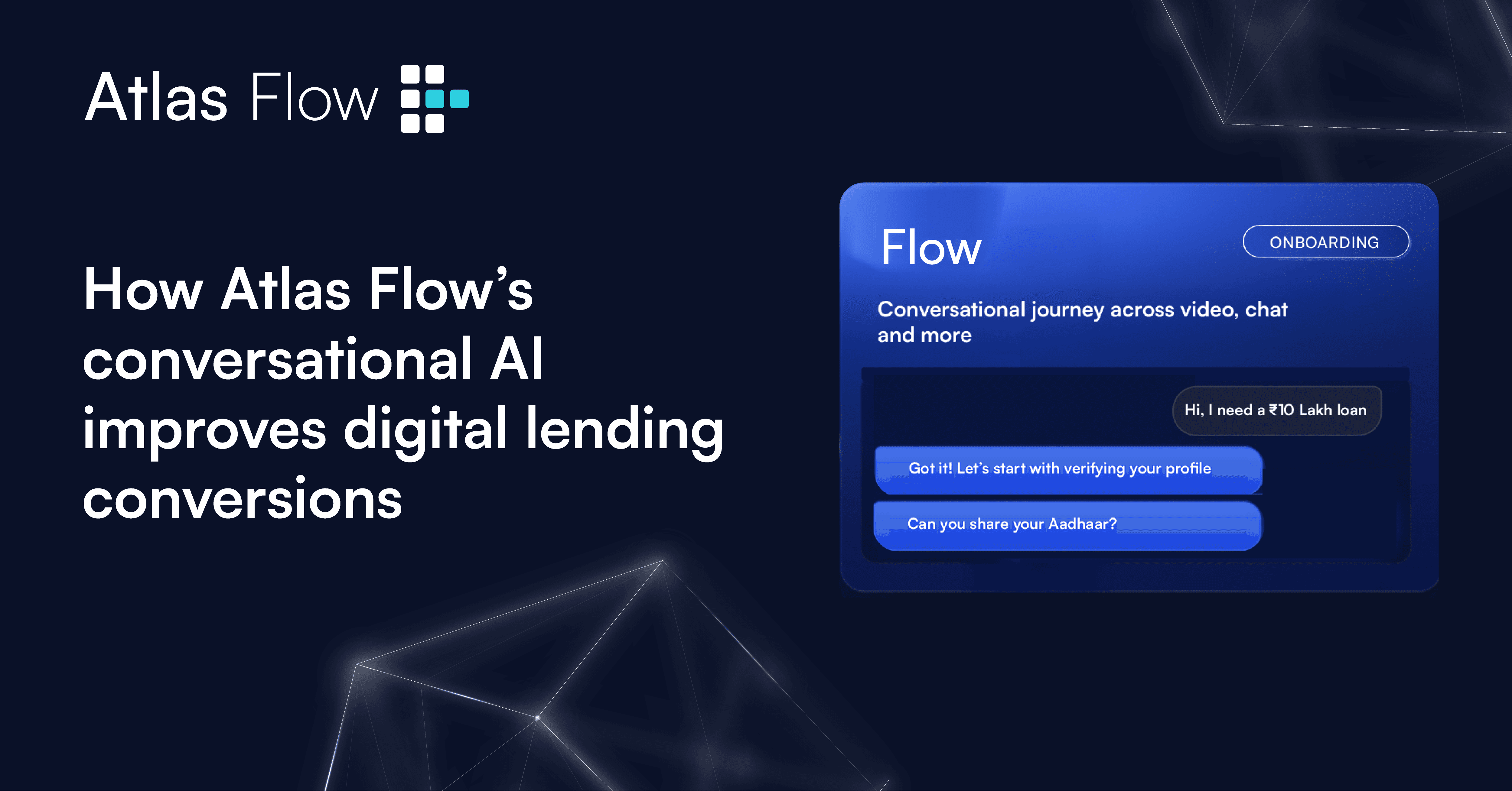
This is the gap Atlas Flow was built to close. The borrower journey runs inside a conversation over chat, voice, or video, in the language the borrower thinks in. An AI agent asks relevant questions, collects the documents an RM would collect, and runs the checks an underwriter would expect. The borrower never sees a form.
Across our early access partners, application completion sits at 85%, against an industry average closer to 40%. End-to-end application time has dropped from 3-5 days to under 10 minutes. A single conversation can absorb 30+ documents without the borrower pre-sorting anything, because the agent classifies and validates each one as it arrives.
Three mechanics drive most of that improvement.
Document quality is fixed in the same conversation. When a borrower uploads a blurry photo or last year's ITR, the agent flags it within seconds and walks them through a re-upload while they're still on the phone. The two-day callback cycle disappears, and so does most of the document chase that consumes RM time today.
Consent capture matches the spirit of the regulation. When a borrower reads a disclosure in their own language and confirms their understanding in their own words, that exchange is time-stamped and logged.
Language stops being a filter on who applies. Borrowers can respond in the language they actually think in, by text or by voice, and they don't need to decode banking jargon. The pool of people who can complete an application without help gets a lot bigger.
What changes for the people on the ground
For relationship managers, the document chase that fills most of the week largely goes away. Files arrive at their desk already complete and verified, which means the first conversation with the applicant is about the loan, not about a missing page on the bank statement.
For sales associates, eligibility is established before they invest time in a conversation. Leads that wouldn't have qualified anyway don't sit in the pipeline pretending to be opportunities.
For credit teams, the input quality of files improves at the source, which compresses the back-and-forth that adds days to TAT for reasons that have nothing to do with credit risk.
The window is narrow
Three things have shifted at once. Voice and multilingual AI models can now handle Indian languages and accents at production quality, which wasn't true eighteen months ago. The RBI's 2025 framework has made conversational, auditable consent capture more defensible than the checkbox-and-disclaimer pattern. And WhatsApp Business has hardened from a marketing channel into infrastructure lenders can build on.
Conversational origination is a competitive advantage right now. Within twelve to eighteen months it will be a baseline expectation, the same way UPI became table stakes for payments.
The borrower is still going to need her loan. The question is whether she gets it from the lender who asks her to resend the same documents three times, or the one that answered in seconds and wrapped up the application in a single conversation.
Atlas Flow is live with early access partners. If you're curious what we're seeing in production, book a demo.