
How Atlas Origin delivers First Time Right documents for secured lending

Nitika
Specialist - Product Content
|
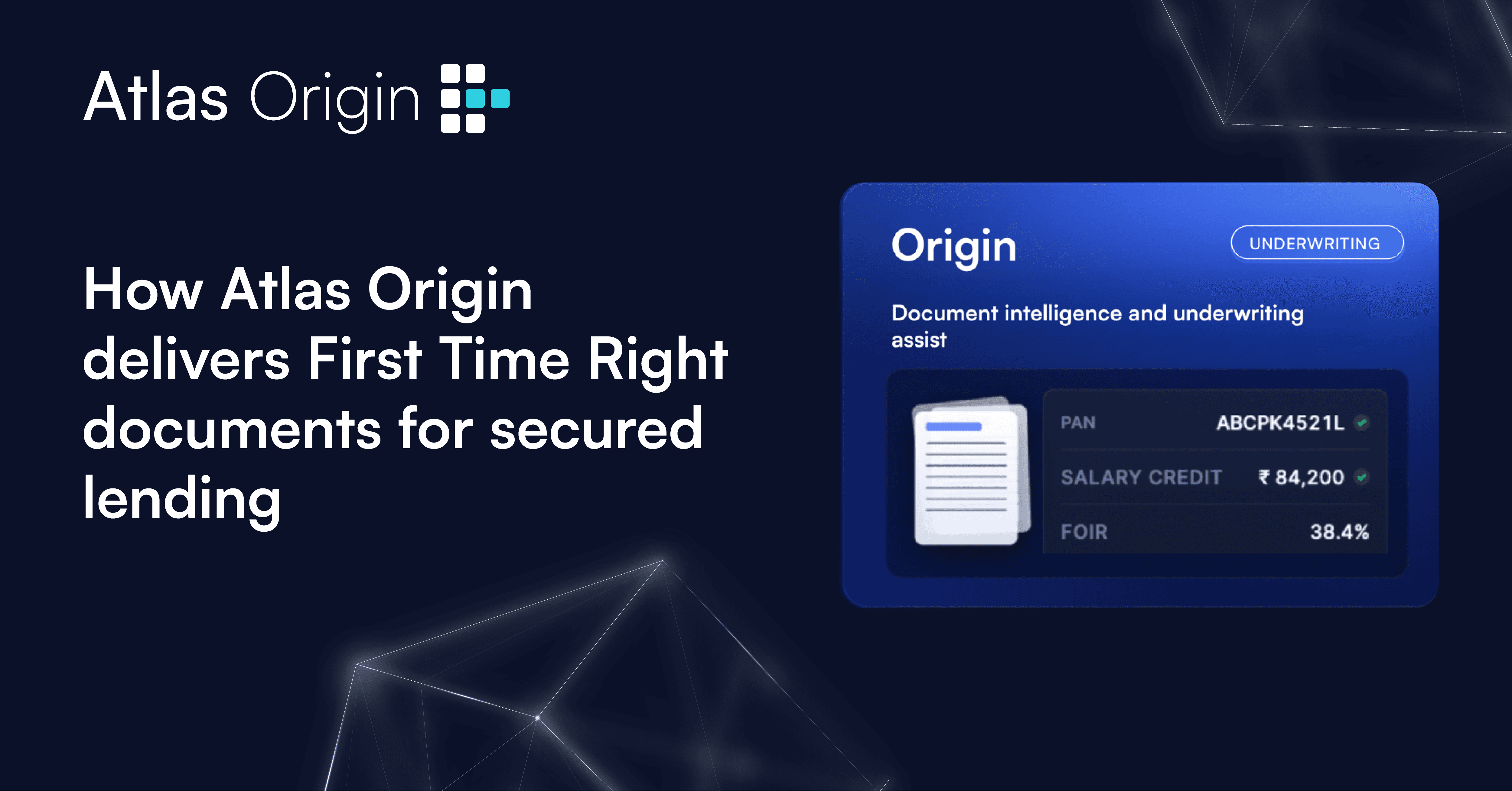
Rajan, a small business owner in Pune, is trying to get a loan against property (LAP) for six weeks. The money is meant to fund a new production line, an opportunity that won’t wait. But his application is stuck in a loop that has nothing to do with his creditworthiness.
His Aadhaar card address doesn’t match his KYC form. His property documents are in Marathi, and the scanned image of his sale deed is blurry. Every time such an error gets flagged, it goes back to his relationship manager, who chases Rajan, who resubmits, and the file reenters the queue –– back to square one. Again.
This is not an anomaly. Every month, 22 million consumers in India seek credit and 70% of them end up dropping out midway because the process defeats them.
Paperwork that breaks processes
The small-ticket LAP segment, predominately used by MSMEs and self-employed borrowers, is growing at 20-25% annually. NBFCs and HFCs are the primary drivers of this growth, moving faster and more flexibly than banks.
The reason why larger players haven’t entered this segment isn’t risk aversion. According to ICRA, it’s because the segment is operationally intensive.
Documents arriving across chats, website, and portals. Income statements in four different formats. Address that doesn’t match across documents. Every application is complex, expecting a human to assemble it piece by piece, before a credit decision can even begin.
It’s not a credit problem. It’s a document problem.
Across lending workflows, lenders consistently lose significant portion of process time not because borrowers are uncreditworthy, but because the documents they submit are incorrect, unclear, inconsistent, or incomplete. The most common problems include:
Wrong document type
Documents are unclear, in regional languages, or partially captured
Details don’t match across KYC, income, and address proofs
Each of these triggers the same response: files get pushed back for resubmission. This First Time Right (FTR) failure results in wasted analyst hours, inflated TAT, and frustrated borrowers.
Introducing Atlas Origin
What if document chaos got resolved before it even reaches your LOS?
That’s the premise behind FinBox Atlas Origin. An autonomous AI agent for secured lending journeys that captures, validates, and structures every file — for faster processing and zero errors.
It sits at the lead stage, before an application enters your underwriting funnel, and transforms disorderly document submissions into clean, structured, and verified credit intelligence.
How Atlas Origin kills the resubmission loop
Intelligent document ingestion and classification
Documents arrive in every format possible –– PDFs over email, WhatsApp images, portal upload. Atlas Origin accepts them in bulk and instantly:
Classifies every document under ‘financial’, ‘identity’, ‘property’, ‘employment’, etc. categories
Handles unstructured, scanned, and vernacular-language documents
Guides sales prompts at source
The system tells you if something is wrong, at the point of capture.
Wrong document? Flagged instantly.
Unreadable scans? Flagged instantly.
Mandatory document missing? Flagged instantly.
The correction happens at the source, not later in processing.
Smart data extraction and LOS prefill
Atlas Origin reads and extracts relevant data, so your team doesn’t have to re-key them. The AI-powered tool:
Extracts structured data fields from classified documents (e.g., GST number, trade name, filing date, turnover, and more)
Works across scanned formats and regional/mixed languages
Prefills extracted data directly into your LOS
Loan triangulation engine
The engine validates declared applicant information against extracted document data, and:
Flags any discrepancies before underwriting
Assigns confidence scores to key data points
Identifies document fraud risk signals, identity concerns, and missing credit history
Multilingual AI Assistant
Credit analysts and underwriters can ask the conversational AI interface queries in natural, multiple languages. The AI assistant also generates case summary files, personal discussion interview scripts, and risk analysis.
Built for everyone in the lending chain
Sales and sourcing teams stop wasting time chasing resubmissions. Atlas Origin flags inconsistencies or errors at the source, which means they capture documents right the first time.
Credit operations teams receive cleaner files with less manual scrutiny required. Only structured, classified data that enters the queue, significantly improving TAT.
Underwriting teams get consistent, structured inputs and can make faster, more confident decisions. The triangulation engine means cross-verification, often the most time-consuming process, is already done.
Business leaders see the outcome that matters the most: reduced TAT, lower processing cost per application, and a conversion rate that reflects credit quality rather than operational friction.
Can your back-office operations keep up?
The Indian lending market is at an inflection point. MSME grew 31% in FY2024. The LAP market is on its way to ₹146 lakh crore by 2030. RBI’s 2025 Digital Lending Directions have raised the compliance bar on borrower documentation, making rigorous, traceable document processing a regulatory requirement.
So what gives? The operational model that underlines most of this growth is still largely manual. Data is still being typed from documents into systems. Cross-checks that should happen systematically are happening sporadically.
The lenders who close this gap first, by ensuring First Time Right at the lead stage, will process more applications with the same team, disburse faster, and convert more. The lenders who don’t will continue scaling headcount alongside loan volume, wondering why their TAT isn’t improving.
The documents were there. The borrowers were creditworthy. The process just kept getting in the way.
FinBox Atlas Origin is built to change that.
See it in action
If your team is spending weeks on document review, we’d like to show you what the alternative looks like.