The Pattern #198
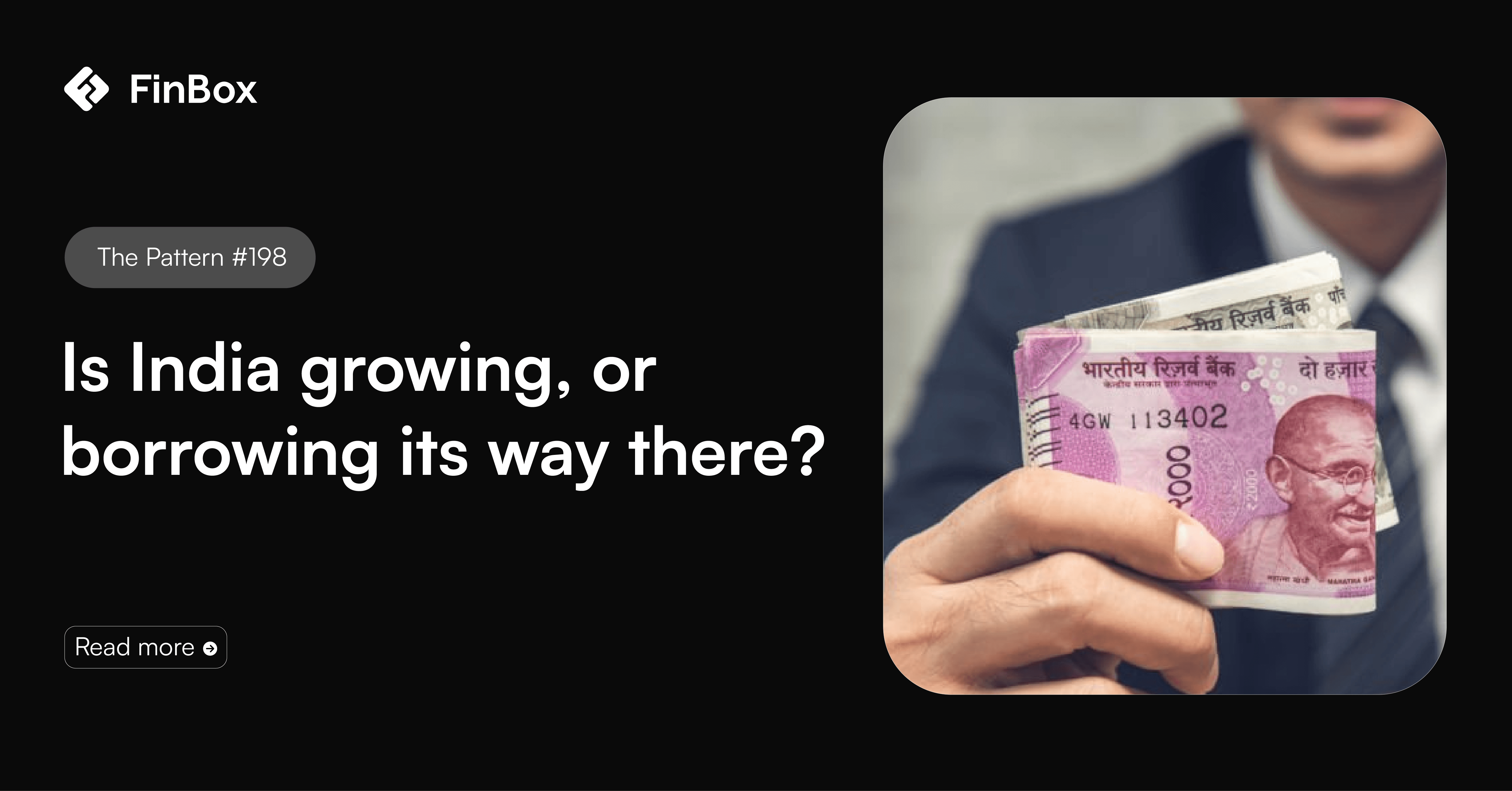
Is India growing, or borrowing its way there?

Mayank Jain
Head - Marketing and Content
·
Hello everyone,
Welcome to the 198th edition of The Pattern, a weekly newsletter on the latest in finance, technology, and the economy.
You’re between meetings, half-reading something, when your screen lights up: “Congratulations, you’re pre-approved.” You swipe it away. A few minutes later, another one. Different sender, same promise. You’ve already cleared a small pile of them and maybe blocked one or two numbers out of habit. I’ve done the same—I’m sure you have too.
The stock market tracks the giants, but these pings track desperation. For the last few years, our fintech ecosystem has been obsessed with money that flows like a breeze. We’ve built a world where credit moves at the speed of a double tap. But as any risk manager will tell you, speed is a liability if the brakes aren’t built for it.
Lately, those brakes have started to squeal. Between the RBI tightening the taps on bank liquidity and global capital sprinting for the exit, easy credit doesn’t seem to be in play anymore.
It may feel like spam, but it’s really a sign of how aggressively credit is being pushed right now.
Stay with me. Let’s understand what’s really happening.
After all, when the tide turns, it’s not always the waves you notice first. It’s what they leave behind. And the first place you see that change is in how credit is being used.
The ₹1.39 lakh crore shadow
Here’s the official number: digital personal loans have ballooned to ₹1.39 lakh crore, with sanctions up 53% in just one year. It’s a huge win in terms of reaching more people. But let’s be real. When your phone pings nonstop with "instant credit" offers, it’s just straight-up credit pushing. We’ve made the "Apply" button so slick that nobody pauses to think about the other side. Repayment?
And that shows up in the data. Household debt has now crossed 41.3% of GDP, with nearly half of these loans going toward consumption, followed by asset creation and productive purposes. In other words, a meaningful share of consumption is now being supported by borrowing. The good news is that Q3 FY26 GDP came in at 7.6%.
But I’d like to double-click here. As more of this borrowing goes into consumption, it hints that credit isn’t just helping people grow—it’s also helping them cope, especially at a time when savings haven’t kept pace. So the rise in personal loans starts to look less like a pure growth story and more like a support system holding things together.
That’s also why the RBI’s move to tighten risk weights on unsecured loans matters. It’s stepping in before things get harder to control. When borrowing grows faster than the buffer behind it, even small shocks can start to feel bigger.
So, the real question is: are we still a consumption-led economy, or is credit increasingly propping up that consumption?
Why is ₹88,180 crore leaving the market?
While domestic borrowing picks up pace, external capital is stepping back. In March alone, FPIs pulled out nearly ₹90,000 crore from India. Nothing fundamentally broke as such, but capital behaves differently when the mood turns uncertain.
With tensions building in West Asia, investors are retreating to safety: the US dollar.
It isn't a specific vote against India; it is simply capital seeking comfort. However, it serves as a reminder that global capital stays while things feel stable and moves the moment they don’t. If a system leans on it too much, it begins to feel brittle.
As domestic growth leans more on credit, external capital is becoming more selective.
Goodbye one-tap, hello accountability
Starting April 1, the RBI is making two-factor authentication mandatory for all digital payments.
For years, the fintech world pushed back on this. In the race for growth, every extra click felt like an eye roll. We spent a decade trying to make payments feel invisible, so fast you barely noticed them happening.
That speed came at a cost. Fraud has become so constant and sophisticated that "invisible" payments started meaning "invisible risk." Those three extra seconds at checkout might feel like a tiny step backward, but they’re actually a much-needed reality check. It’s a small price to pay for knowing your money is safe.
The RBI’s tactical silence
You know that feeling when you're a little short on cash before payday, so you decide to skip a non-essential purchase? That’s basically what the RBI just did.
They were supposed to sell Treasury Bills this week, but they pulled the plug at the last minute. Why? Because the "price" of money (interest rates) got too high. Banks are currently stretched thin—tax season is draining their reserves, and everyone is still borrowing heavily.
When the RBI saw that investors were demanding higher returns, they didn’t panic or push through. They simply stepped back. It was a tactical move to keep the system from getting even tighter. It’s a good reminder: even for a central bank, sometimes the smartest move is to do nothing at all.
A reset in how India grows
For the last decade, we’ve judged progress by how much we could automate, how quickly money could move, and how little we had to think about it. Growth felt easy, mostly because it didn’t ask much from us.
But the numbers this week tell a different story. A bit of friction is coming back, not as a setback, but as a reset. Whether it’s the RBI adding an extra step for security, tightening liquidity, or global investors becoming more cautious, things are starting to shift. Growth is becoming more deliberate.
The noise on your phone might not stop tomorrow, but the lenders behind it are finally being pushed to show how they manage risk. We’re moving away from the “one-tap”
Reading list
Digital personal loan book tops Rs 1.39 lakh crore; sanctions jump 53%
India's household debt rises to 41.3% of GDP, above five-year average: RBI
RBI tightens norms, raises risk weights for personal loans and credit cards
FPIs pull ₹88,180 cr in Mar, 2026 outflows cross ₹1 trn on West Asia war
RBI’s new 2FA rules kick in April 1: Know what changes for users
Thank you for reading. If you liked this edition, forward it to your friends, peers, and colleagues. You can also connect with me on X here and follow FinBox on LinkedIn to get the latest updates.
See you next week.
Cheers,
Mayank
All opinions expressed are my own and do not necessarily reflect the views of FinBox or its promoters.
